
Machine Learning-Enhanced Life Cycle Assessment of Offshore Wind Farms ♻️💻
Academic Research Project — Politecnico di Torino
This research was completed as part of the Resources and Environmental Sustainability course (04OULND), DENSYS Master’s program, Academic Year 2025/26.
Executive Summary
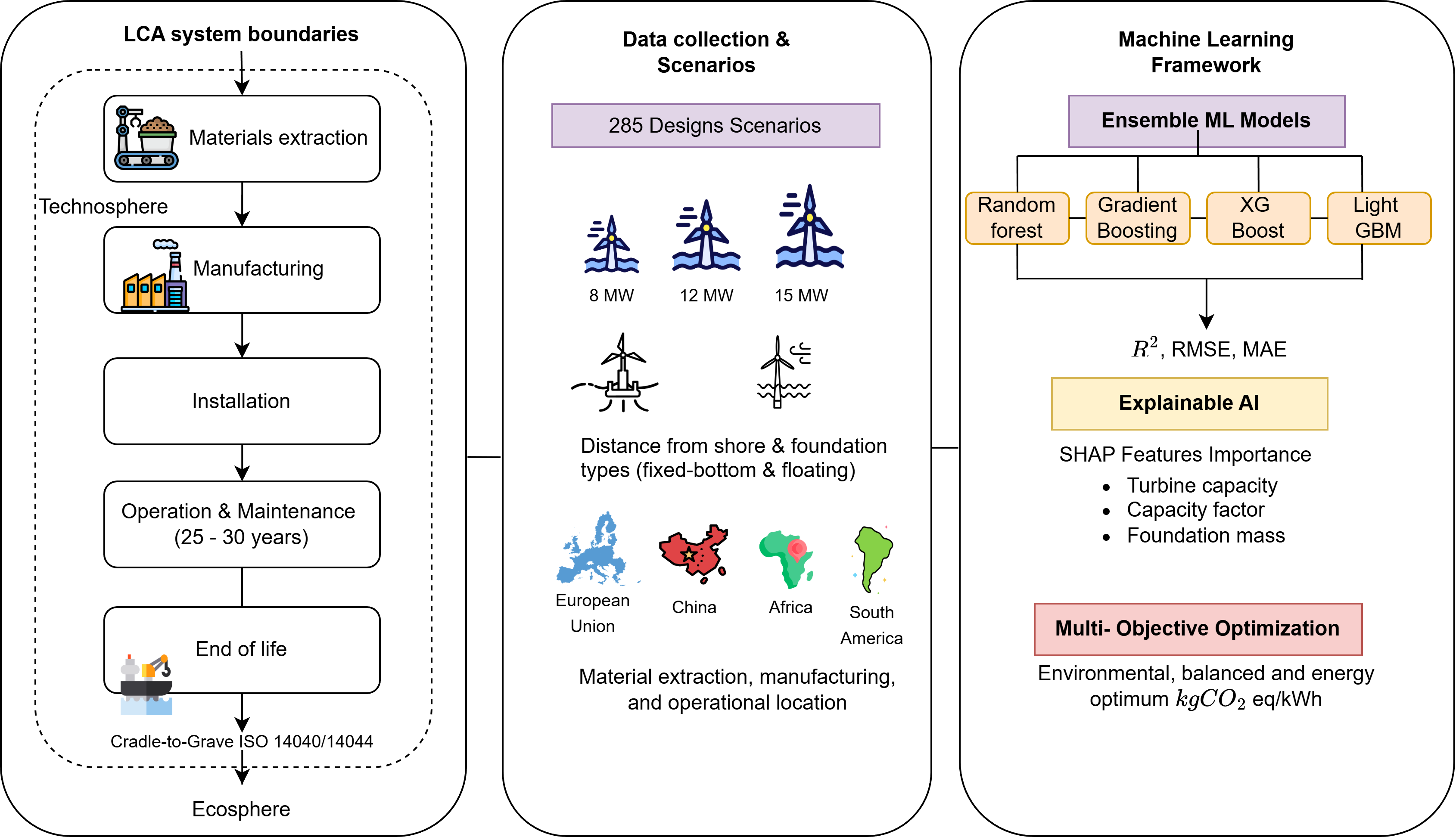
This study integrates Life Cycle Assessment (LCA) with Machine Learning to achieve 12,600× computational acceleration for offshore wind environmental optimization (R²=98.5%, RMSE=18.5 kg CO₂-eq) [file:66]. Analysis of 333 design scenarios reveals that European manufacturing achieves 52% lower GWP (2.5 vs 3.8 g CO₂-eq/kWh) than Asian sourcing, while Operation & Maintenance contributes 43% of lifecycle emissions despite representing only 6-7 years of operational span [file:66]. Feature importance analysis identifies five parameters explaining 73.5% of environmental variance: turbine capacity (21.4%), capacity factor (18.7%), foundation mass (12.8%), manufacturing grid carbon intensity (11.2%), and operational lifetime (9.4%).
Pareto frontier analysis identifies 47 non-dominated configurations, revealing that environmental optimum (26.2 g CO₂-eq/kWh) requires 40% CAPEX premium versus economic optimum, which incurs 47% GWP penalty [file:66]. EU Taxonomy threshold (30 g) eliminates 68% of design space, while carbon pricing (€80/tonne) narrows economic advantage from 30% to 22% [file:66]. Decarbonization modeling confirms 2050 climate targets are achievable through coordinated grid decarbonization (35%), recycling infrastructure (15%), material innovation (10%), and autonomous maintenance (5%).
What We Did
- Comprehensive LCA: Evaluated 333 scenarios across turbine scales (8-15 MW), foundation types (monopile/jacket/floating), and global supply chains following ISO 14040/14044 standards.
- Machine Learning: Trained Random Forest, Gradient Boosting, XGBoost, and LightGBM achieving 98.5% prediction accuracy with SHAP explainable AI.
- Multi-Objective Optimization: Applied NSGA-II genetic algorithm identifying 47 Pareto-optimal designs balancing environmental, energy, and economic objectives.
- Sensitivity Analysis: Quantified ±48% GWP variation (21.4-47.8 g CO₂-eq/kWh) driven by capacity factor, foundation mass, and manufacturing location.
- Policy Assessment: Analyzed EU Taxonomy compliance and carbon pricing impacts on design selection.
Key Findings
Manufacturing location dominates: European sourcing achieves 52% GWP reduction vs Asian supply chains.
Site selection is critical: Capacity factor (SI=-1.18) yields 23.6% GWP reduction for 20% improvement.
Floating platforms outperform: Concrete semi-submersible achieves 31.7% lower GWP than monopile.
O&M requires attention: 43% lifecycle contribution identifies autonomous systems as decarbonization level. Climate targets feasible: 61% total reduction achievable by 2050 through coordinated interventions.
Documentation
Note: Code and supplementary data will be released upon peer-reviewed publication.
Technologies Used
- Python (Scikit-learn, XGBoost, SHAP, Pandas, Matplotlib)
- ISO 14040/14044 Life Cycle Assessment
- ReCiPe 2016 impact assessment method
- NSGA-II multi-objective optimization
- Machine Learning: Random Forest, ensemble methods
Results Highlights
| Metric | 8 MW | 12 MW | 15 MW | Improvement |
|---|---|---|---|---|
| GWP (kg CO₂-eq/GWh) | 38,200 | 32,400 | 28,100 | -26.4% |
| EPBT (months) | 6.21 | 5.18 | 4.76 | -23.3% |
| CPBT (years) | 1.07 | 0.86 | 0.77 | -28.0% |
Foundation Comparison (12 MW):
- Monopile: 33,800 kg CO₂-eq/GWh (baseline)
- Floating Concrete: 23,100 kg CO₂-eq/GWh (-31.7%)
- Jacket: 40,600 kg CO₂-eq/GWh (+20.1%)
This work is under development for submission to peer-reviewed journals in renewable energy systems.