
Chuong Dang TA
Hi! My name is Chuong Dang Ta. [translate:Chương] is my Vietnamese name, and yes, it’s tough for foreigners to pronounce (but no hard feelings toward my parents for that 😅).
Currently, I am pursuing a Master’s degree in Decentralised Smart Energy Systems (DENSYS), studying at Université de Lorraine, Nancy, France and Politecnico di Torino, Italy. I expect to graduate in September 2026. I am currently working as a Junior Data Scientist at rebase.energy in Stockholm, developing autoregressive power forecasting models for Wave Energy Converters with a Multi-Ridge Regression stack, and forecasting wave energy flux from ERA5 ocean wave data by benchmarking regularised and tree-based models against probabilistic methods (Quantile Regression, Quantile Regression Forests, bootstrapped residuals). Previously, from February to July 2026, I carried out my Master’s thesis here, forecasting wind turbine icing power losses using an extended IEA Wind Task 19 framework and a two-stage LightGBM classifier-regressor. Professionally, I’m driven by challenges in Offshore Wind, Wave Energy, and Power-to-X, a passion amplified by the time I worked as Junior Researcher at VPI - Vietnam’s Petroleum Institute — contributing to Vietnam’s national hydrogen roadmap. My goal is to return and help advance this transformation.
Last year, I watched a great video on how to learn machine learning, and it made me realize that most people skip the fundamentals and jump straight into a bootcamp. Here’s a meme that captures this tendency. Personally, I really enjoy learning from textbooks on topics that interest me, it’s one of the best ways to build a concrete foundation of understanding! For instance, I am currently reading the book Hands-On Machine Learning with Scikit-Learn, Keras, and TensorFlow and expect to finish it by the mid of September.
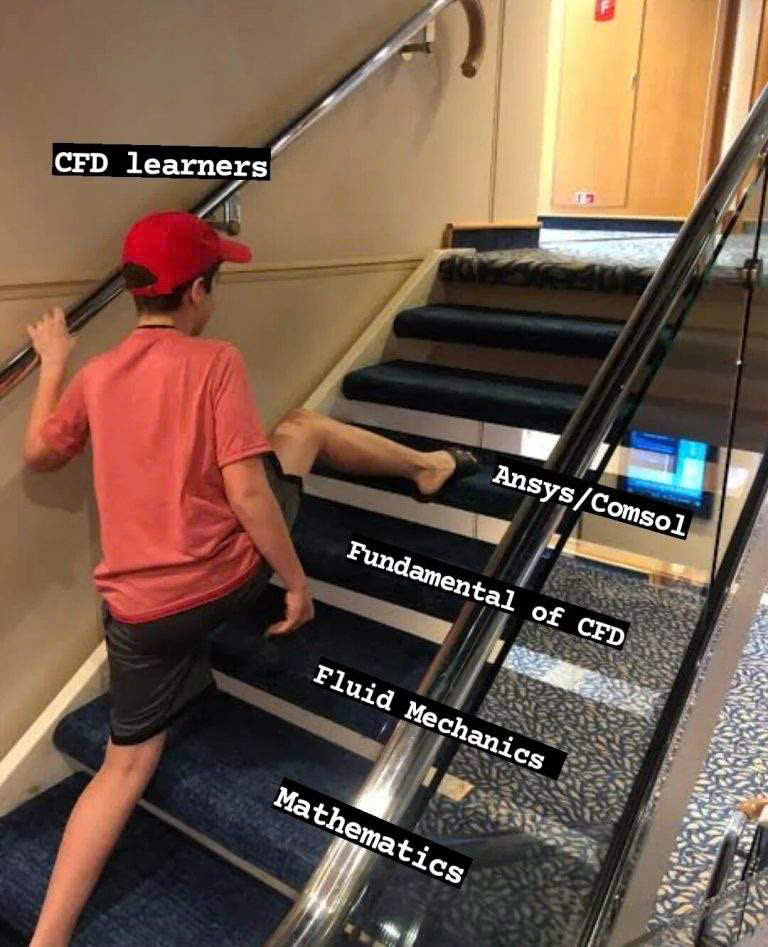
Many learners leap straight to tools like Ansys/Comsol in CFD, skipping mathematics and core fundamentals.
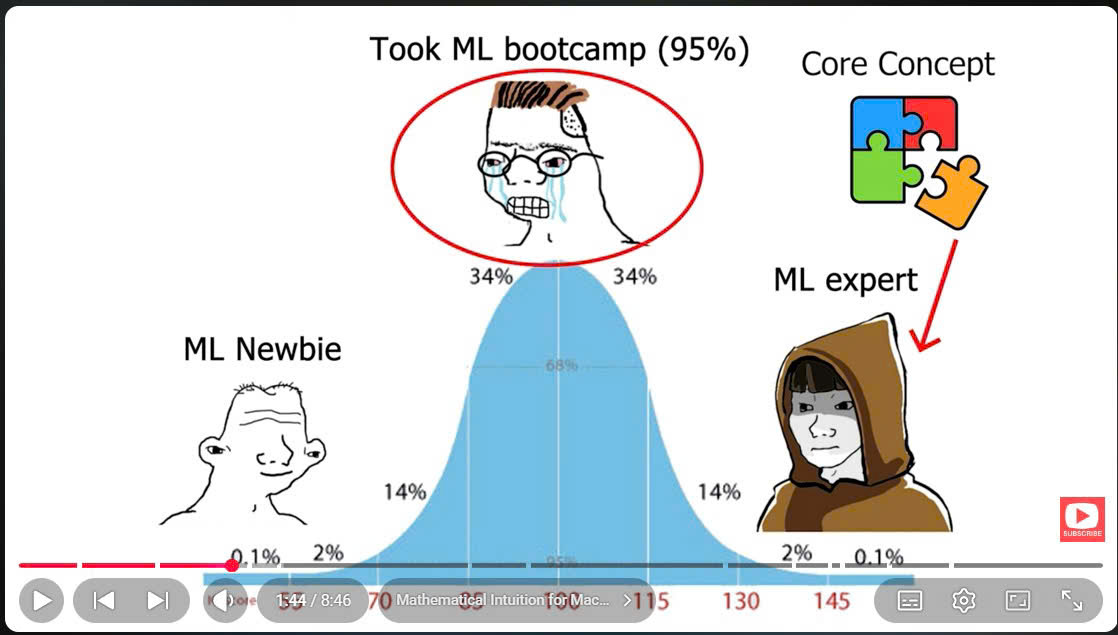
Most people rush into ML bootcamps without core concepts; textbook learning helps reach true expertise.
I have hands-on experience with PyWake, an open-source, Python-based wind farm simulation tool developed at DTU, which computes flow fields, power production of individual turbines, and Annual Energy Production (AEP) for entire wind farms. I modeled a project using PyWake that gave me practical insights into wind farm aerodynamics. I also intend to learn TOPFARM, a Python package from DTU Wind Energy that wraps PyWake with OpenMDAO, enabling wind farm optimization for both onshore and offshore projects.
Education
Université de Lorraine, Nancy and Politecnico di Torino, Turin
MSc in Decentralised Smart Energy Systems (DENSYS)
France & Italy
Selected Coursework: Wind and Ocean Energy Plants, Data and Forecasting in Microgrids, Optimal Local Design Energy Networks, Polygeneration and Advanced Energy Systems, Smart Electricity Systems, Chemical and Electrochemical Processes
Key Projects: ML-Enhanced LCA of a North Sea Offshore Wind Farm (12,600× computational acceleration, R²=98.5%); Techno-economic and environmental assessment of algae-based SAF pathways.
Master's Thesis: Icing and power loss forecasting for cold-climate wind farms using SCADA and NWP data (rebase.energy, Stockholm, Feb–Jul 2026)
Hanoi University of Science and Technology (HUST)
BSc in Thermal Engineering
Hanoi, Vietnam
Thesis: Techno-economic analysis of internal combustion engines using Diesel and LNG (Grade: 9.5/10)
Honors: Merit Scholarship and JNED Award for nuclear research, Japan (2023)
Selected Research Experience
Junior Data Scientist, rebase.energy
Jul 2026 – Present, Stockholm, Sweden
Autoregressive power forecasting for Wave Energy Converters via a Multi-Ridge Regression stack (Elastic Net and LightGBM), and forecasting wave energy flux from ERA5 ocean wave data, benchmarking regularised and tree-based models (Elastic Net, Random Forest, LightGBM) against probabilistic methods (Quantile Regression, Quantile Regression Forests, bootstrapped residuals).
Master Thesis Student, rebase.energy
Feb 2026 – Jul 2026, Stockholm, Sweden
Labeled icing events on multi-year Swedish turbine SCADA data using an extended IEA Wind Task 19 Sigmoid Performance Ratio framework, corrected SCADA-ERA5-Land biases with Quantile Mapping, and used Spearman/SHAP screening to select stable predictors. Built a two-stage LightGBM classifier-regressor with walk-forward cross-validation to forecast icing losses at 1-36 hour lead times, showing SCADA signals dominate near-term skill while NWP forecasts matter more for longer horizons.
Junior Researcher, Vietnam Petroleum Institute (VPI)
Feb 2024 – Aug 2024, Hanoi, Vietnam
Contributed to national hydrogen roadmap by conducting feasibility studies for green hydrogen integration into thermal power plants. Focused on techno-economic modeling, cost benchmarking, and policy analysis for power sector decarbonization.
Research Intern, Vietnam Initiative for Energy Transition (VIETSE)
May 2023 – Sep 2023, Hanoi, Vietnam
Modeled solar/wind/BESS hybrid power systems using HOMER Pro and Python. Analyzed performance and policy impacts in Vietnam and Thailand, contributing to stakeholder reports on renewable integration and energy security.
Selected Projects
See the full write-ups at chuongta.github.io/EnergyForecasting.
- LLM Assistant for Operational BESS Dispatch — Integrated LightGBM day-ahead price forecasting with a Pyomo scheduling model, using a local LLM agent to query and explain optimal battery dispatch schedules.
- Probabilistic Electricity Price Forecasting — Developed day-ahead price forecasting models (Quantile Regression, Quantile Regression Forests, and bootstrapped residuals) on Danish DK1 data, evaluated with walk-forward validation.
- Smart Heat Pump Control — Built a physical model and Gradient Boosting digital twin of a heat pump, using Reinforcement Learning (PPO) to optimize thermal storage dispatch for price arbitrage.
- Stochastic Storage Optimisation — Developed a two-stage stochastic battery scheduling model in Pyomo, using probabilistic forecasts to optimize dispatch under price uncertainty.
Publications
Wind Farm-Scale Forecasting of Turbine Icing Power Losses Using Multi-Ridge Regression Models [Ongoing]
Dang-Chuong Ta et al.
Based on MSc thesis research at rebase.energy, extending the turbine-level classifier-regressor framework with multi-ridge regression models and upscaling to wind farm-level forecasts.
Feasibility Analysis of Hydrogen Co-Firing in Vietnam's Gas Power Plants for the Period 2035–2050 [Journal Article]
Dang-Chuong Ta, Thanh-Hoang Le, Long Van Phan, Hoang-Luong Pham
Energy Conversion and Management, Impact Factor: 11.8, 2025
DOI: 10.1016/j.enconman.2025.120192
An Assessment of the Potential for Large-Scale Hydrogen Export from Vietnam to Asian Countries: Techno-Economic Analysis, Transport Options, and Energy Carrier Comparison [Journal Article]
Dang-Chuong Ta, Thanh-Hoang Le, Hoang-Luong Pham
International Journal of Hydrogen Energy, Impact Factor: 9.2, 2024
DOI: 10.1016/j.ijhydene.2024.04.033
Technical Skills
- Machine Learning: Supervised, unsupervised, and reinforcement learning; hybrid, physics-informed models for energy system forecasting and predictive maintenance.
- Data Science & Optimisation: Applied MILP, MINLP, and heuristic algorithms (e.g., genetic algorithms) in Pyomo to optimize renewable energy systems.
- Technical Toolset: Python (PyTorch, Scikit-learn, TensorFlow, Pyomo, PyWake), Ollama (local LLM), Git, Julia, MATLAB/Simulink, Modelica, QBlade, HOMER Pro, GIS, Aspen Plus, Typst, LaTeX.
Honors & Awards
- Erasmus Mundus Scholarship (DENSYS, EU)
- JNED Award, with site visits to nuclear power plants and research facilities in Japan, 2023
- Merit Scholarship (BSc at HUST, Vietnam)
Languages
- Vietnamese (Native)
- English (IELTS 7.5, full professional proficiency)
- German (A2), French (A1)
Referees
Prof. Fabrice Lemoine — Chair of the DENSYS Erasmus Mundus Joint Master Degree, Université de Lorraine
fabrice.lemoine@univ-lorraine.fr
Marta Gandiglio — Associate Professor, Department of Energy (DENERG), Politecnico di Torino
marta.gandiglio@polito.it